Sunday, March 17, 2013

So Many Monsters: The Axebeak

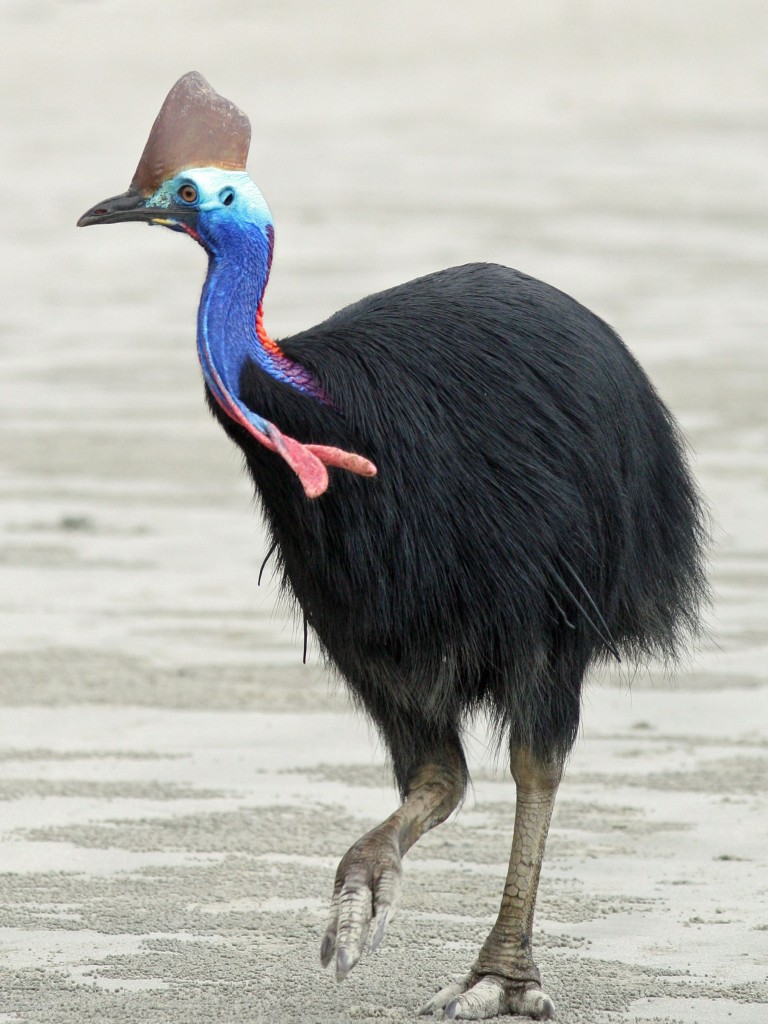
The axebeak, or terror bird, is just a poor man's velociraptor. Really. If you're going to have a big flock of screeching biting clawing two-legged hatebeasts leap out of the jungle from the wrong epoch in your game why aren't you using raptors? Unless you just want an exotic pet for the indolent menageries of the shadow elves, in which case I recommend jeweled raptors, or possibly cassowaries.

(Fig. 1: So cool.)

Axebeaks do have some potential as mounts, like in Final Fantasy (the chocobo) or Golden Axe (whatever that thing was). Bird mounts are fast and weird and brightly colored and kind of primitive looking (but not as overtly pulpy as dinosaurs) - all good qualities to have in a mount. And I think I've mentioned already how birds are just about the most ill-tempered and filthy creatures alive, so having to ride one is pretty much putting up a big sign that says Civilization: The Other Fucking Direction.

So mount up your kobolds or your cannibal halflings and have at it. Just remember... those axebeaks could have been scythe-clawed reptiles that can open doors.

(Fig 2: I'm comfortable with my choice.)

So Many Monsters: The Aurumvorax

The aurumvorax always felt pulpy to me, like something you'd find escaped from the holding pens in the crashed spaceship dungeon. Is it the eight arms? The shiny raygun-gold color? Not sure but it's a pretty cool little beasty.

Something else to try: aurumvorax as Guardian Lions (aka Fu lions, lion dogs, Shishi, Qilen, whatevs). Animal statues that come to life to protect a location. Maybe bronze, maybe gilded, maybe actual (magically hardened) gold - as much a status symbol as a guardian.

(like this but with more legs mebbe)

The Aurumvora  - more commonly known as Greeds - were creations of the seven ancient Empires of Sin. They guarded treasuries and temples (often the same buildings) and their teeth were often enchanted to turn intruders' bodies into gold with a single bite. Greeds were favored for their opulent golden coats, their ability to sniff out precious metals, and their immunity to rust monsters.

Other pets of the Sin Lords include the Leucrotta (or Envies, foul and unsightly badger-deer able to mimic a voice with perfect accuracy after eating the speaker's tongue) and the Folivora (or Sloths, two- or three-toed tree climbers that moved so slowly their fur became host to memory-eating Obliviax moss).

Sunday, March 10, 2013

So Many Monsters: The Ankheg


True story: in one of my first high school campaigns a player noticed the ground trembling while on his way to the moathouse of the Temple of Elemental Evil. He immediately declared he was jabbing his spear into the ground and (despite considerable penalties for full concealment and cover) rolled a critical hit for more than double max damage. The burrowing ankheg (a random encounter) died before it had even breached the surface. The player never saw what he had killed.

So of course he assumed he had killed the earth. For the rest of the campaign, every desert, every blighted battleground, every dead tree... "It's all my fault! Gods, WHAT HAVE I DONE?!"

Yeah. High school.


I've always thought the marines in Starcraft must have the suckiest job ever. Not just because they're always getting killed by grotesque insectoid monsters, but because those monsters could jump out of the ground at any time.

Ankhegs are hideous chitin-covered acid-spitting bugs that could jump out of the ground at any time and kill you. You could also use giant termites, or kruthics, or zerglings, but ankhegs do the job.

Thanks, ankhegs.

So Many Monsters: The Aboleth

Today we're talking about the aboleth!

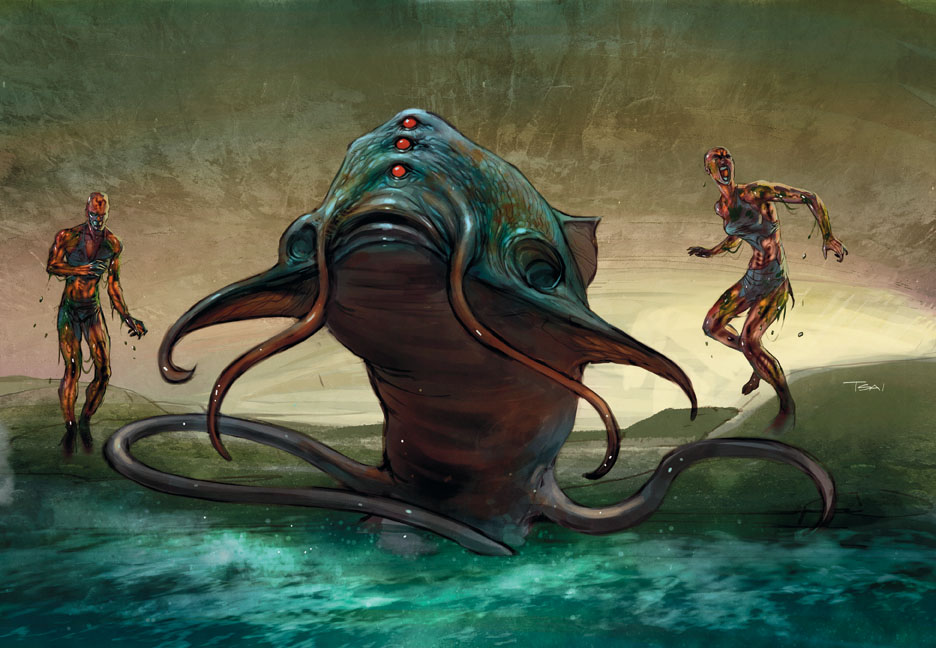
That's the original, AD&D Monster Manual 2 illustration for the aboleth. Here's the two newest versions, from 4th Edition...


...and concept art from D&D Next:


Remember in Ridley Scott's Alien, when the whole movie you just saw little glimpses of the alien and then at the end when Ripley blew it out the airlock you saw the whole thing and even with its giant spine protrusions and cockroach-black skuttliness it was just a guy in a suit with a dick-shaped helmet?  I think the newer pictures of the aboleth are kind of like that, except replace 'guy in a suit' with 'evil catfish'.

Granted, catfish are freaky-ass animals and noodling just proves we're even weirder. Still. Fish. It's not threatening, it's tasty.

Writhing mouthparts and slime and tentacles and too many eyes on something that's ambiguously a head and certainly not a face... something where you'd feel unclean knowing one had been nearby... yeah. Yeah, more of that. 

As in any good Lovecraft story the real horror is that people worship this thing, this slimy spasming horror that makes you need to bathe just looking at it, there are whole temples, whole towns of people who love this thing and will do anything to enact its will. You look at the creature and it doesn't look intelligent, it looks like filth, but the wise old priest and the senator and your best friend want to attach it to your face.

And then it starts to crawl inside your thoughts and you realize they were right all along.

So Many Monsters: The Aaracokra

So there's this book called the Monster Manual, right? And it's where (pretty much) all the iconic D&D monsters come from. And on this here blog I'm going to go through it and offer my thoughts on those monsters, because monsters are pretty darn cool.

Stop me if you've heard this one.

Okay yes not the most original idea. But a uniquely D&D idea. Other games have a set world or backstory and you can talk about your theories on where the Scarlet Empress went or what mages were active in 1920s New York, but D&D expects you to make your own setting. I don't know the history of your campaign world (and I'd likely find it as tedious as you'd find mine) but if you're playing D&D you probably have goblins of some sort and liches of some sort and if you've got a unique spin on those that's something I'd like to hear about and maybe incorporate.

Used to be all the worlds had a bridging cosmology in common - Sigil, the Great Wheel, the elements - but that got scrapped 13-odd years ago now, and talking about it is likely to start bickering about editions. Or ranting about how kids these days don't understand how amazing Planescape was, which is pretty much the same thing but more bitter and true.

The other common ground is alignment, but... no, let's not.

Monsters.

First up we have... the aarakocra? Sure, let's go with that.


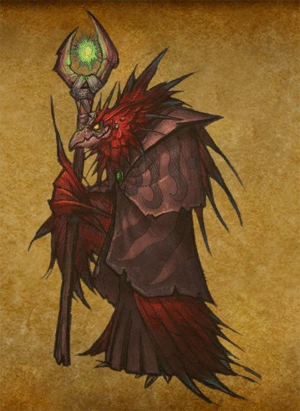
Bird people. I can get behind bird people. Birds are nasty, filthy creatures - I understand not eating beef or pork because cows and pigs are kind of smart and personable, but chickens man fuck those guys a foot-cube industrial metal cage is too good for them. For aarakocra (or arakkoa, if you don't mind a Blizzardism and don't want players snickering at the cock in the middle) I'd play up the tattered violent bastard angle, make them the bad-tempered hobos of the humanoid races. Bit of Skeksi, bit of... whatever those things were in the mind-swap episode of Farscape (okay those were pretty much Skeksi too). Myth II had the bre'Unor, evil jawbone-throwing pagan types, who worshiped a "profane spirit of elemental air" they believed would become a god if it could feed on the last breaths of their dying enemies. That's totally metal so I steal it pretty much every chance I get, but it fits for dirty air elemental-summoning bird men more than most.

A whole group of javelin-throwing, barbed whip-swinging avians swooping down on travelers through the high mountain passes is a pretty cool image, and would make for a damn difficult fight. Could be fun difficult or frustrating difficult depending on how many ranged options the party had. Bring nets!

China Mieville's Perdido Street Station also had the garuda, which would be another way to handle these, just not a very interesting one. Garuda are proud and obsessed with freedom and live in the desert and hate cities. They're... kind of dull? But the book does give an excellent sense of how unsettling and alien something with a frickin' bird head would be to interact with, all unreadable and predatory, and how huge a bird of about human height would feel. Their bodies are all head and torso, their heads are all jagged killing beak, and their wingspans are so much more than their height. Like with giant eagles you always know this thing is built to rip your face off and eat it.

So take all that and make them also worship a profane spirit of elemental air that wants to suck the dying breath from your lungs. Much better.

(Next up's the aboleth. I'm excited.)

Sunday, February 10, 2013

Beasts of the Dark Zodiac


(Expanding on an idea from Noisms' Forge Monsters challenge.)

Time in the world above is measured by the progress of the moon, sun, and planets - an endless cycle of months and seasons and years. The zodiac divides time into increments and assigns each increment certain traits - an element, a mood, and most prominently, an animal. But while one born in the year of the Monkey may share the beast's cleverness and joy, the spirit of Monkey cares no more for dates and calendars than it does oceans or asphalt. The animal gives its name to the year, but that animal's god is not a god of time.

Below ground the stars are hidden and the seasons pass without notice. Time passes at the pace of shifting continents. Years are not named, but imposed. If the signs of the zodiac still bare the names of animals it is only because those creatures choose to make it so, because they find such ordered delineation useful.

The twelve beasts of the dark zodiac are prophets, sages, historians. Each is immortal - perhaps a god, perhaps just fantastically old. Naturally, all are completely mad, though some do well to conceal it.

Some find communication with the surface world suits their agendas, and have gained a certain notoriety. The Skull Hermit deals in cataclysms and the death of gods. The Wyvern of the Well can answer any question, but only once the question is asked. The Weaver considers itself an artist, beautifying the future's web of possibilities by violently cutting certain threads. Many-as-One, a rat king of unequaled population, reads the fortunes of cities by crawling through their entrails.

Others are less well known:

Grandmother Scorpion, five-tailed and bloated, can poison time itself, granting visions of one's past or future, prolonging life, or aging one to dust in an instant. Attending her is a cult of hideously withered elves, and she speaks through a mummified head and torso affixed to the end of her largest stinger. The price for her venom is a fresh elven sibyl, delivered within a year. To ensure the deal is kept she injects a thought-delayed poison that persists through magical healing, resurrection, reincarnation, and if all else fails, lineage.

Echo Serpent is an enormous, blind white rattlesnake that hunts by sonar like a bat. When its warning rattle echoes off cavern walls the echoes themselves are serpents, writhing shadows that strike and then vanish in a hiss of air. It is old as all Creation - not the tempting serpent of Eden, but born of the same divine word. If you tell the serpent a lie, it will whisper the lie back, and the lie will twist and coil in your brain until you tell it again. The thrice-told lie will deceive even gods, as long as telling it causes harm.

Still Carapace - a gnarled, chitinous old thing, not quite roach or trilobite - predates not just this multiverse but several others as well. Witness to the destruction of countless worlds (and countless more extinctions), Still Carapace is the best possible sage on all matters eschatological. Problem is, no one else can verify a damn thing the old bug says, to tell if the rituals he spits are meant to avoid yet another apocalypse, or cause a disaster only he knows how to survive.

Even more obscure beasts include a vampire bat that feeds on entropy (with anticoagulants in its bite that cause bleeding portal-wounds between worlds), a giant house centipede with antennae sensitive to temporal intrusion, and a planar mollusk with the black pearl of a new underworld accreting beneath its shell.

Tales of a "memaggot" that hides its own existence by eating thoughts as they putrefy into memories, and the ramblings of one amateur magician regarding a so-called "deep crow", are rightly dismissed as total bullshit.

Saturday, February 9, 2013

Skills, part 3: The Skill List

More on skills. See also my initial thoughts and revised skill rules.

My skill list is very 4th Edition derived, so run away if that's not your cup of tea. I used 4E as a starting point because it's a short list but pretty much anything you can think of falls under one skill or another. Plus, realism be damned, lumping all the thief skills together and the burly movement skills together and the magical knowledge skills together makes it easy to just be good at your job and still have some points for fun flavor stuff.

You could base all of what your character knows and can do on your class, but I rather like the idea of a commando-type fighter who knows how to hide in shadows or a rogue who knows a bit of the arcane.

I avoid having skills required or limited by class for the same reason. I've never known a thief who didn't want the full suite of thief abilities but if you want to just be a knowledgeable expert of the Van Helsing school that's just dandy. And the skills outside the norm for your archetype are going to be far more interesting than the ones that every fighter (or whatever) chooses by default. Plus, a pick-what-you-will skill list feels a lot simpler than having a unique class kit or feat or prestige class for every type of character you can think of.

Sometimes I want to expand the list I have to make it an even 20 skills - being able to roll a d20 (say) three times for an NPC and knowing what they can do and what they've prioritized learning sounds like a nifty little trick. But really that would just be padding the list for liking round numbers, so I've stuck with these 18.

Acrobatics: Flipping around and walking on narrow ledges and other nimbly ninja tricks. I don't have formal rules for attacks of opportunity but I give characters with lots of Acrobatics more leeway in describing how they avoid the big hulking brutes in their path. More Acrobatics makes it more justifiable to try fancy swashbuckling movie shit, which is never a bad thing.

Arcana: So Spellcraft is the practical manipulation of magic, but Knowledge: Arcana is knowing about magic, I guess? And Concentrate is something else entirely? And Alchemy is maybe its own skill or maybe a specialized subset of Craft? Nuts to that. Arcana is the magic skill. With enough of it you can identify spells or magic items and such - maybe I'll have you roll, but only when not giving information or telling horrible horrible lies would be as interesting or more interesting than the truth. Having a skill for aura reading rather than a spell to cast over and over that says "yup, there's magic here" is wonderful.

Athletics: The other physical action skill. Kind of ambiguous whether this or Acrobatics covers jumping - in real life you jump with your muscles but flying around like a tweaking chipmunk is usually something the halfling wants to do. I like to split the difference and use Acrobatics for gymkata parkour and Athletics for long-distance huuuurrrr leaps. Honestly though if you wanted to really condense the skill list you could fold the Acrobatics stuff in here too - there's some overlap with climbing already, and it's not like adventurers willingly go in the water ever so you don't really need to worry about the swimming application. One skill for all the movement stuff just seems implausibly broad though, so I keep them separate.

Bluff: Lies, damn lies, and misdirection. You can't just say "I bluff him! I rolled a 7!" of course, but higher Bluff lets you get away with more on sheer chutzpah (technical term). Superhuman levels of Bluff probably let you get around mind reading and such, though admittedly it hasn't come up yet.

Craft: 4th Edition didn't have a Craft skill. I thought that was stupid. 3rd Edition had a ton of crafts but you couldn't use it to save money and the rules for crafting times were go-sit-in-a-corner-level BAD MATH, so I cut all that out and made Craft one skill. Obviously Craft: Baking and Craft: Weaving and Craft: Golemancy are all very different (unless you're making a Lattice-Crust Pie Golem, and if so I salute you), but I'm okay with that. No one has a problem with a local knowledge skill covering every city ever, so in my games Craft is the generic skill for making And fixing stuff (and also sometimes sabotaging stuff), and at high levels you can make magic items if you have the tears of a phoenix and the beard of a fish or whatever. If that kills your sense of realism you can pick an area of expertise and everything else is at one or two mastery levels less. Metallurgy's kind of like printmaking, right?

Diplomacy: As with Bluff, Diplomacy should not let players say "I roll Diplomacy!" and have that be their argument. Diplomacy gets rolled because both the incredible result that leaves a whole village inexplicably smitten and the natural 1 that causes a huge international kerfuffle are results I like to see, and if there's a skill associated I can let the dice decide which happens first.

Endurance: The theory was having this skill let you make a marathon runner or the sort of fighter you see in epics where fighting someone to a standstill takes days and people stay awake without food or water all that time by sheer power of badass. Or like the fellowship chasing the uruk-hai across the plains nonstop for a week. But in actual play none of that ever happens, because it's hard as a player to set up situations where your Endurance matters and as a DM if you make it so players need to stay up for a week the one Endurance guy will be like "Okaaay..." and everyone else will have to sit that adventure out. In conclusion: Endurance is bad and I'm a bad person for not realizing it earlier. Moving on.

History: Real-life history is great because it's full of cool stories and characters. Fake history (or "adventure background") is lame because if you want to talk about the what happened in the Aztec-Atlantean-Alien Empire you should be playing the game in that era, or showing what the Empire was all about by just letting their ancient machines come to life and try to kill people. So if I could take away everyone's character sheets and make a few judicious edits I'd rename this Geography and make it the skill for knowing what's all out there in the world in the present. Either way it's a knowledge-type skill, so you're letting a player decide "My character's really smart so I want to be the font of exposition." You shouldn't roll dice for this unless failing to remember something has comical and/or deadly consequences.

Insight: Also known as Sense Motive. I love this skill because when players use it and realize "Hmm this dude's kind of skeezy we better keep an eye on him" they feel like the skill gives hidden life-saving information, and when they don't think to read someone and that person stabs them in the back they blame themselves for letting their guard down, not me for surrounding them with treacherous backstabbing liars. You don't need Insight for this - ask about a schemer and, skilled or not, you'll almost always hear some variation of "He's definitely a bastard but he doesn't seem interested in killing you right now" - but having the skill is a nice comforting security blanket so you can sleep in a world of manipulative pricks.

This is taking longer than I thought so I'm going to play the Harry Potter card and split this last skill post in half. Stay tuned for Skills: Part 4: The Skill List Part 2: Breaking An Unexpected Hollow!